
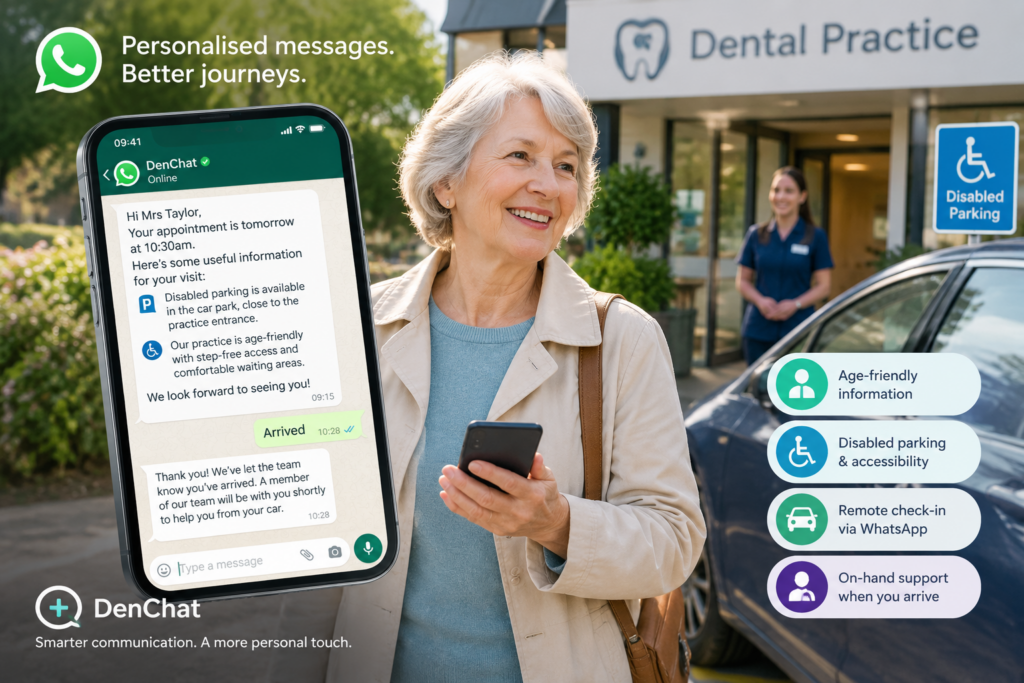
From remote check-in to truly personalised patient support, DenChat is helping dental practices use patient data to deliver a more thoughtful, inclusive experience.
DenChat has enhanced its AI-powered WhatsApp functionality to help dental practices do more than simply remind patients about appointments, provide useful information on the day and enable remote check-in.
The latest development allows practices to send bespoke, highly personalised messages to patients, using relevant information held within the Aerona practice management system (PMS).
This means communications can be tailored to individual patient cohorts — including, for example, a patient’s age profile or physical ability — helping practices provide information and support that is genuinely relevant to the person arriving for their appointment.
Making patient communication more personal
Traditional automated patient communications tend to take a one-size-fits-all approach. Every patient receives broadly the same reminder, regardless of their individual circumstances.
DenChat’s enhanced functionality provides practices with an opportunity to change that.
By using selected data items from Aerona, practices can identify particular patient groups and create communications designed around their specific needs.
For example, a practice may want to provide older patients with information about age-friendly access, or let patients with mobility difficulties know about disabled parking facilities close to the practice.
Rather than expecting patients to search for this information themselves, the practice can proactively put it in front of them as part of their appointment communication.
It is a relatively simple change, but one that can make a significant difference to the patient experience.
A real-world example of putting personalisation into practice
One UK dental practice is already using the enhanced functionality to provide additional information to specific cohorts of patients.
Patients who may benefit from additional assistance can receive information about age-friendly facilities and disabled parking in the vicinity of the practice, helping them plan their journey and feel more confident about attending their appointment.
But the practice is taking the concept of personalised service one step further.
When an eligible patient remotely checks in through DenChat on WhatsApp, the practice can provide hands-on assistance when they arrive.
For example, a patient can simply send the message “arrived” via WhatsApp.
The practice knows that the patient is there and, rather than leaving them to make their own way from the car into the practice, a member of the team can go outside to assist them.
That could mean helping the patient out of their car, accompanying them into the practice or providing whatever additional support is appropriate.
The technology is therefore not replacing the human element of care. It is helping the practice know when and where that human support is needed.
Turning patient data into better service
The development demonstrates how data held within a PMS can be used for more than administration.
With the right functionality and appropriate use of patient information, practices can turn data into more relevant communication and more responsive patient service.
Age, physical ability and other appropriate patient characteristics can help practices think differently about the experience they provide.
For an older patient, that might mean clear information about accessible parking and additional assistance on arrival.
For a patient with mobility difficulties, it could mean knowing that someone will be available to help them from their vehicle.
For the practice team, it means having greater visibility of who may need additional support and an opportunity to prepare for that patient’s arrival.
From remote check-in to remote reassurance
Remote check-in has already made the appointment journey more convenient for many patients. DenChat’s enhanced functionality adds another dimension: remote reassurance.
Patients can receive information that is relevant to them before they arrive, while the practice can be prepared to provide the right level of support when they do.
The result is a more connected journey:
Personalised message → informed patient → remote check-in → “arrived” notification → appropriate human assistance.
It is a good example of how digital technology can support — rather than distance — the relationship between a dental practice and its patients.
Putting inclusion into everyday patient care
Accessibility and inclusion are increasingly important considerations for healthcare providers. Yet delivering an inclusive experience is not only about the physical environment.
It is also about how patients are communicated with, how easy it is to access information and whether the practice anticipates individual needs.
By enabling practices to tailor communications according to relevant patient characteristics, DenChat gives practices another way to make accessibility part of the everyday patient journey.
And importantly, the approach can be highly practical.
A message about accessible parking may help someone plan their journey. A simple WhatsApp “arrived” message can alert the team that assistance is required. A member of staff being ready to help can turn what might otherwise be a difficult arrival into a smooth and welcoming one.
Technology that enables better human care
The evolution of DenChat’s WhatsApp functionality reflects a broader opportunity for dental practices: using technology not simply to automate tasks, but to make patient care more personal.
AI and automation can handle the communication and identify the relevant information. The practice team can then provide the human response.
For patients who need additional support, that combination can be particularly valuable.
The ambition is not to make the patient journey more automated for the sake of automation. It is to make it more personalised, more accessible and more human.
With DenChat’s enhanced integration with Aerona, practices can now use relevant patient data to deliver communications that recognise individual needs — and, when a patient arrives, help ensure that the right person is there to help.
Because sometimes the most valuable outcome of digital technology is knowing when a human being is needed.